



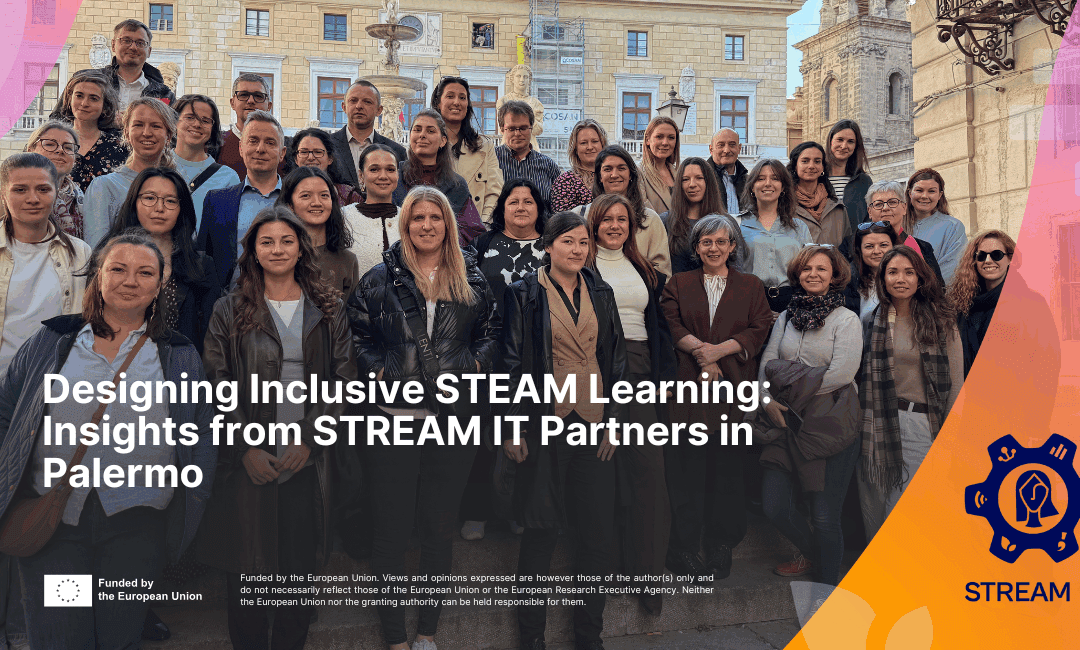
How can STEAM learning environments become genuinely gender and diversity inclusive and not simply reinforce existing stereotypes or create new ones? This question guided a rich discussion among STREAM IT partners during the 4th Assembly Meeting in Palermo. As project activities of Work Package 3 (WP3) progress toward developing a set of practical toolkits for teachers, mentors, and learning facilitators, partners focused on a central challenge: How can STREAM IT ensure that every learning activity truly supports gender inclusivity – without reinforcing hidden biases or unintentionally emphasising gender differences that may lead to unequal learning opportunities?
The answer, partners agreed, lies in context, language, facilitation, and design choices, all requiring teachers’ self-reflection first. The Palermo meeting was a turning point, transforming abstract principles of inclusivity into concrete guidelines that will shape the STREAM IT toolkits and teaching resources.
Why STREAM IT Needs Gender-Sensitive Toolkits
STEAM fields continue to face unequal participation rates. But while many initiatives try to “bring girls into STEAM”, these efforts often unintentionally reinforce the idea that the problem lies with girls, and that boys have less to gain from inclusive approaches. Partners also noted a more subtle problem: in today’s narrative, girls can feel they must choose STEAM to avoid being seen as outdated or limited. This means they may move toward STEAM not out of passion but out of fear of appearing “old fashioned”. Such pressure is another form of gender bias – just in reverse. True inclusivity means freeing all young people to choose what they genuinely love, whether it’s engineering, caregiving, robotics, design, or teaching. Partners emphasised that inclusivity works only when it recognises different strengths and encourages collaboration without framing any gender as “better” or needing “fixing”. Inclusive STEAM is not about elevating girls over boys, or boys over girls. It is about aiming for achieving equity trough creating learning spaces where diverse qualities are valued, where everyone feels confident to contribute, and where educators guide this balance with intention and awareness.
What We Learned in Palermo: Core Principles for Inclusive Toolkits
During group discussions, interviews, and brainstorming sessions, several essential principles emerged. These will directly shape the structure, content, and delivery of WP3 toolkits.
1. Neutral, inclusive language matters
Partners stressed the importance of neutral, non-stereotypical language across all STREAM IT materials:
- No “invisible bias” (e.g., defaulting to male examples or describing experiments with masculine-coded metaphors);
- Represent all genders and their interests fairly in examples, instructions, and visuals;
- Avoid positioning one gender as “in need of help” and the other as “the norm”.
Words influence expectations. Expectations influence confidence. When young people hear themselves reflected in learning materials, participation grows naturally.
2. Images and visuals must reinforce inclusivity - not stereotypes
Visual representation is essential. Partners highlighted several practical rules:
- Include girls and boys in all types of activities – not segregated by theme;
- Avoid images that mirror traditional biases (e.g., boys building robots, girls decorating);
- Show mixed groups collaborating;
- Represent diverse role models (“girls can choose any profession,” not “girls need saving from stereotypes”).
Images should show what is possible, not what history has dictated.
3. Toolkits must offer options - not a single “correct way”
The Palermo notes stressed that educators need flexibility:
- Toolkits will offer a menu of activities to choose from;
- Each activity will include guidance on gender-sensitive implementation;
- Variations will demonstrate how the same activity can work across different age groups, contexts, and class dynamics.
This avoids prescriptive teaching and instead empowers teachers to adapt resources meaningfully, and a side effect improves the quality of the teaching.
4. Mixed groups are key but success depends on the context
Partners highlighted an important nuance: mixed groups do not automatically produce inclusive outcomes. Success depends on how groups are structured; how tasks are assigned; how facilitators ensure equal voice; how stereotypes are addressed explicitly when needed. The STREAM IT toolkits will therefore include:
- prompts for group facilitation;
- strategies to ensure quieter students speak up and take leadership roles;
- guidance on preventing dominant individuals from overshadowing others;
- instructions on coaching collaboration skills.
Educators are central as they are the ones who can create safe, balanced spaces where every learner feels equally valued and encouraged.
5. Boys also face stereotypes and need awareness
One of the strongest messages from Palermo was that inclusivity is not only about empowering girls. Partners noted that boys also face pressure (e.g., to perform, to appear confident, to avoid “creative” or “care” roles). Inclusive STEAM must challenge assumptions on both sides and activities should highlight that “strengths” differ, not “capabilities”. Educators must address stereotypes openly to break the cycle for everyone.
6. Role models and context make a real difference
The partners agreed that showing relatable role models is essential, thus role models should be presented carefully: not “superhuman female scientists” who feel unrealistic and not portrayals that suggest one gender is more innovative. Instead, role models who communicate that science is collaborative, creative, and accessible. Context is equally important. For example, framing a robotics task around real-life relevance, using examples from everyday problems, showing how STEAM skills help solve societal challenges. Context invites engagement; role models build confidence.

Key Takeaways from Palermo
STREAM IT partners concluded that gender sensitivity in STEAM education must go beyond “adding girls”. It involves designing content with awareness, selecting visuals responsibly, facilitating collaboration intentionally, challenging stereotypes for all genders, emphasising strengths, not deficiencies, empowering educators as inclusion leaders. Inclusive STEAM happens when educators create spaces where students of all genders learn from each other, not in competition but in collaboration.
Conclusion
The conversations in Palermo provided the foundation for a set of toolkits that will equip European educators to create STEAM learning environments where every student can thrive. As WP3 moves forward, these insights will shape every activity, visual, instruction, and piece of guidance produced by STREAM IT. Our goal is to help educators create learning journeys where inclusion is the default, diversity is celebrated, and every learner feels confident exploring STEAM.
Sunrise Tech Park
Evelina Šalavėjienė, Project Manager at Sunrise Tech Park and Work Package 3 Leader in STREAM IT. Evelina specialises in coordinating international partnerships, and developing tools that help schools and educators create engaging, equitable learning environments. Passionate about innovation, education, and community impact.