



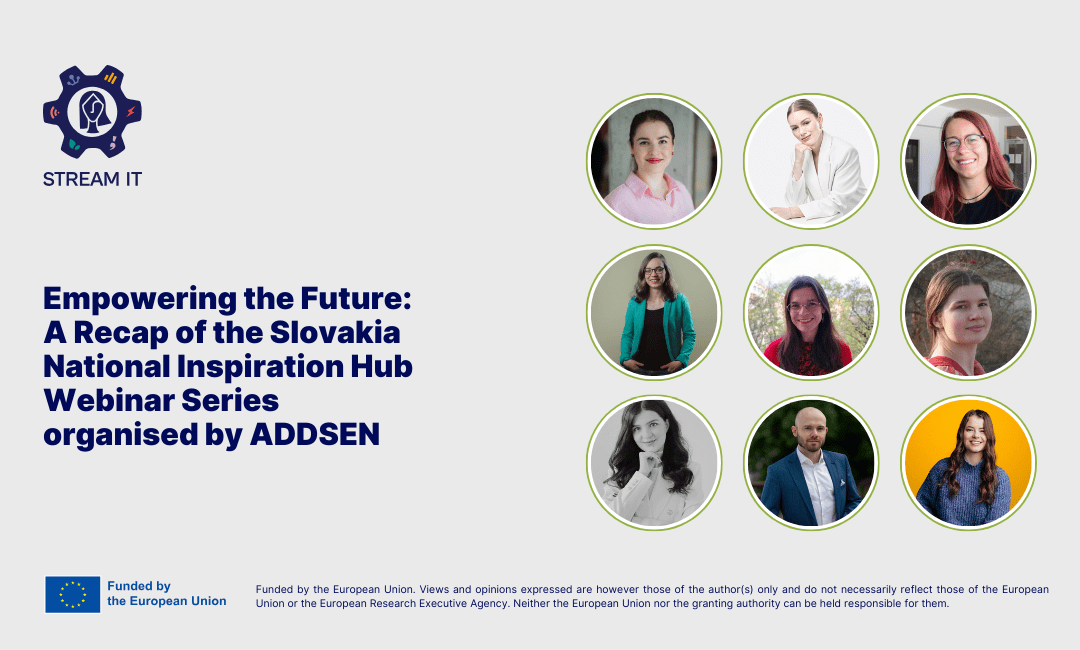
From practical digital tools to revolutionary project-based learning models, this series served as a bridge between current classroom realities and the future of innovation. Whether you missed a session or want to revisit the insights, here is a complete roundup of our Slovakian NIH journey.
1st webinar: “Innovative Approaches and Activities in STEM Education”
The Hook: How do we bridge a gap where only 18% of the IT workforce is female? Our first webinar tackled this head-on, focusing on how educators can dismantle stereotypes and turn informatics from a “daunting subject” into a creative playground for girls.
Led by Lucia Husenicová and Zuzana Reptová, the session introduced the project’s core goals: strengthening gender equality and providing practical tools for educators. Alžbeta Palkoci from Ženský algoritmus shared how initiatives like X Factor Tech (an online IT course for girls), Coding Camp (a free project-based summer program), Tech Internship Program and Inspiring Roles (school visits by successful Slovak women) provide the safe, hands-on environment girls need to thrive. Beyond theory, the session provided a “digital survival kit,” showcasing tools like Miro for collaboration and Google Arts & Culture for interdisciplinary learning.
- Key Takeaway: Representation matters. School visits by successful women (Inspiring Roles) and exposure to AI-based tools like Desnfortbet are the sparks that ignite a student’s interest.
- Watch here: YouTube Link
2nd Webinar: “Best Practice Sharing: MyMachine Slovakia, EduB, SAVIA”
The Hook: How do you turn a 6-year-old’s “dream invention” into a working prototype? Through MyMachine Slovakia. This webinar showcased the power of interdisciplinary collaboration, where children’s sketches become university engineering projects. We also heard from EduB, who are revolutionising biology by taking it out of textbooks and into the real world.
Žofia Teplická explained the MyMachine model, where primary children invent, university students design, and vocational students build – a process that has yielded 82 inventions over nine years. Meanwhile, Kristína Hudáková and Jarmila Šimková from EduB highlighted the STEP correspondence seminar, which treats high schoolers like real researchers through scientific problem-solving and lab visits. Together, they demonstrated how to make science relevant and engaging for all students.
This webinar was led by ADDSEN’s partner organisation SAVIA (Slovak association of women in science, research and innovation), concretely Janka Kottulová.
- Key Takeaway: STEM is most powerful when it is hands-on. When children see their ideas come to life through collaboration, their confidence in their own creative potential skyrockets.
- Watch here: YouTube Link
3rd Webinar: “Motivating Girls to Pursue STE(A)M Study Paths and Career”
The Hook: Why do girls aged 13 to 19 often opt out of STEM? It’s rarely about ability and often about a lack of “belonging.” This session focused on how educators can help girls overcome barriers and discover the confidence to pursue technical career paths.
Alžbeta Palkoci shared insights from a decade of youth work, identifying hurdles like low confidence in math and the absence of female peers. The session focused on creating “aha moments” – turning points where girls realise STEM is accessible and relevant to them. Strategies included using anonymous digital tools to surface fears, organising “Inspiring Girls” visits, and creating peer communities where authentic conversations about expectations can happen freely.
- Key Takeaway: Use anonymous digital tools to surface real fears and questions. This creates a safe space for authentic conversations about stereotypes that often block career paths.
- Watch here: YouTube Link
4th Webinar: “Best practice sharing: P-Mat and Skyro”
Date: December 1st, 2025
The Hook: What happens when you replace traditional tests and homework with individual mentorship and real-world challenges? You get Skyro, a private tech-focused secondary school designed for the modern industry. We paired this fresh approach with P-MAT, an organisation that has spent 20 years proving that the process of solving a problem is more important than the final answer.
Viktória Jakubovičová introduced Skyro’s philosophy of personalised learning paths, where AI is used to support critical thinking. Following this, Renáta Klimanová shared how P-MAT’s nationwide seminars in math, physics, and biology encourage students to improve their solutions repeatedly based on expert feedback. Together, they showed that nurturing talent requires moving away from “one-size-fits-all” grading and toward resilient, creative discovery.
- Key Takeaway: Personalised learning paths allow students to excel in their strengths rather than being forced into a rigid mold. Mentoring is the ultimate bridge between schooling and the modern workforce.
- Watch here: YouTube Link
5th Webinar: “Digital Tools for Teachers”
The Hook: How can teachers work smarter, not harder? This session was a masterclass in using concrete digital tools to make lesson planning easier and student projects more vibrant.
Simona Šimovičová from Ženský algoritmus broke down Trello for project management and task tracking, helping teachers define what “done” truly looks like for student groups. She also explored Canva for Education, demonstrating presentation tricks like “magic” confetti and phone-based remotes. Finally, the session introduced Pitch Perfect, a rapid-fire invention game that helps students – especially girls – build the confidence to present entrepreneurial ideas under pressure.
- Key Takeaway: Technology should simplify, not complicate. Tools like Canva for Education can transform a standard worksheet into an inspiring resource in minutes, saving teachers time while boosting engagement.
- Watch here: YouTube Link
6th Webinar: “Best Practice Sharing: Future Generation Europe (Mini Erasmus) and DASATO”
The Hook: How can young people make informed life choices in a rapidly changing world? By “test driving” their future. Our final webinar looked at how experiential learning helps students move confidently from the classroom into their careers.
Terézia Mihalovič Lukáčová from DASATO explained how their academies help students tackle real-world challenges alongside professionals, focusing on self-awareness and 21st-century skills. Matúš Jarolín from Future Generation Europe then introduced the Mini Erasmus program, which allows high schoolers to attend real university lectures and meet students before choosing their degree. Both programs prove that hands-on experience is the best antidote to career indecision.
- Key Takeaway: Experiential learning – actually sitting in a university lecture or working on a corporate challenge – is the most effective way to strengthen motivation and help young people make realistic life choices.
- Watch here: YouTube Link
Conclusion: A Community of Change
We invite all teachers, parents, and students to join the STREAM IT community. The journey doesn’t end with these webinars; it begins with the actions you take in your classrooms and communities today. Let’s continue to empower the next generation of Slovakian innovators!
Huge thanks to Lucia Husenicová and Zuzana Reptová from ADDSEN, and Janka Kottulová from SAVIA, for organising and moderating these truly insightful webinars.
Author
F6S Innovation
Melissa Tang, Communication Manager at F6S Innovation, plays a pivotal role in various EU-funded initiative. Her expertise, built on a foundation of a BA in Design and Advertising and a Master’s in Communication and Media Studies, is further strengthened by hands-on experience leading communication, dissemination and exploitation efforts in over 15 research and business projects.