



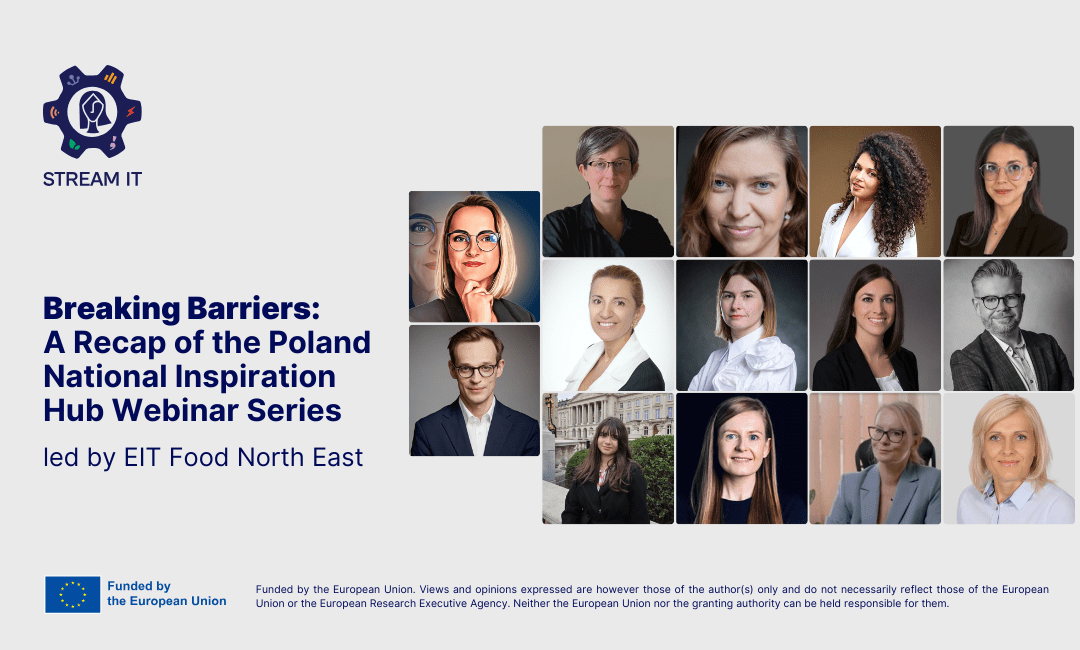
In early 2025, the STREAM IT project expanded its impact to Poland under the unifying theme: “STREAM IT – Supporting learners, shaping the future.” Organised by EIT Food CLC North-East, this National Inspiration Hub (NIH) webinar series served as a critical platform for educators, researchers, and academic leaders to dismantle the systemic barriers preventing girls and women from flourishing in STEAM.
By blending high-level research with grassroots teaching strategies, the Polish series aimed to transform how science and technology are taught from preschool to university, ensuring that every learner has the support needed to shape a better tomorrow. Here is the detailed summary of our journey.
1st webinar: “STEAM Without Barriers: The Foundation for Change”
Date: March 26th, 2025
The Hook: A shift in teaching methods only begins when we stop asking if barriers exist for women in STEAM and start asking how we can dismantle them. Our inaugural Polish webinar brought together higher education experts to move beyond theory and toward structural, institutional reform.
Led by experts from the HÉTFA Group and EIT Food CLC North-East, the session grounded the project in real-world data. Katalin Oborni, the STREAM IT coordinator, emphasised that effective education must be tailored: we need to acknowledge the specific needs of both girls and boys to create a truly inclusive environment. Małgorzata Druciarek (EIT Food CLC NE) followed with a powerful look at qualitative research, arguing that the most effective way to support women is through formalised, institutional support implemented at the highest levels.
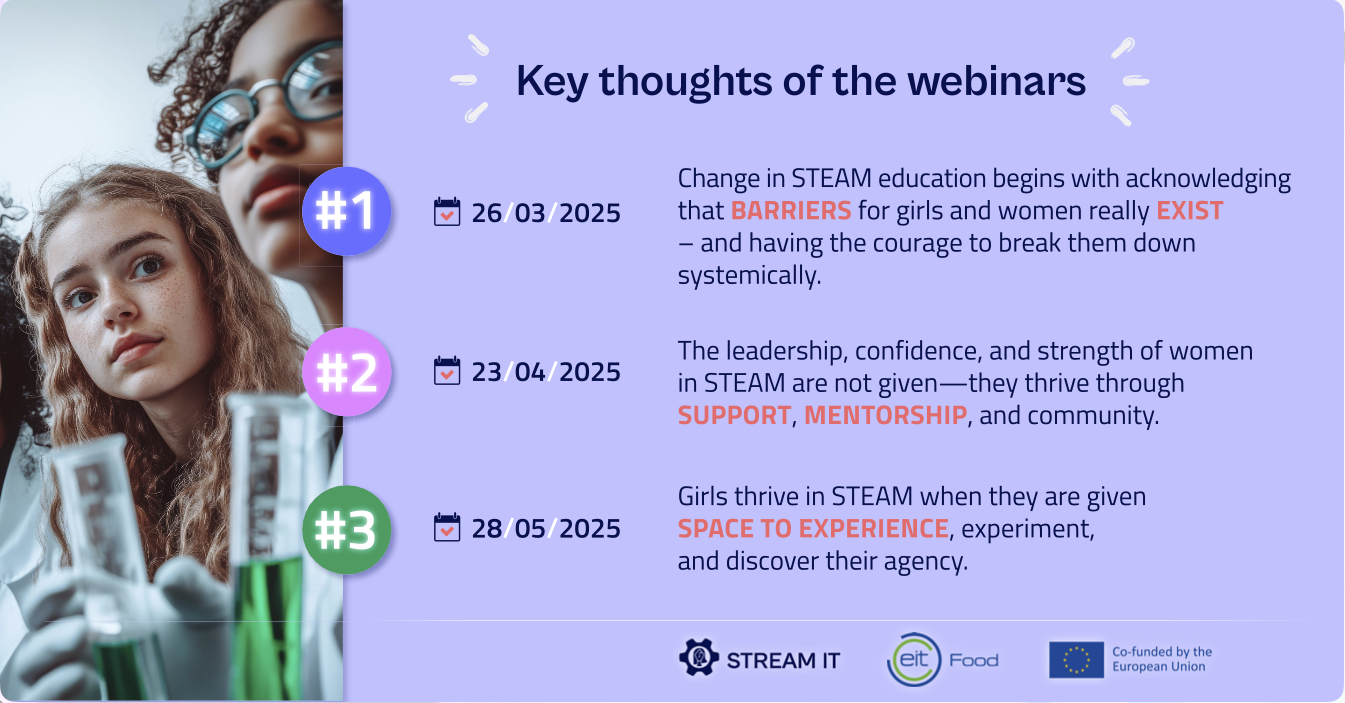
- Key Takeaway: Teachers are the primary “agents of change.” By training educators to see gender as a lens for learning and providing strong collaborative networks, we shift the culture from one of competition to one of mutual support.
- Watch here: Youtube Link
- Additional Recommendations:
-
- Gender-inclusive STEAM education – Supporting girls from an early age (preschool, primary school) in pursuing education and careers in STEAM fields is crucial. Initiatives like STREAM IT can help eliminate barriers and equip teachers with supportive materials.
- The role of teachers in STEAM is key – Engaged, well-trained, and gender-aware teachers are essential. Teacher training should focus on implementing gender-sensitive teaching methods – educators should be able to see gender as an aspect of learning, not just a topic.
- STEAM is the future of education – Interdisciplinarity and the integration of science with practice prepare students for the challenges of an evolving job market. Creative teaching methods make STEAM more engaging (more fun, less theory – especially for younger learners). Additionally, a practical approach for educators should include gender-related topics and methodologies (e.g., working with data that highlight gender inequalities, participatory methods) and curriculum revisions.
- Support networks and role models in STEAM inspire – A key element of STEAM development is a strong network of women supporting each other – creating a culture of collaboration rather than competition and facilitating the exchange of experiences between teachers, experts, and young learners. Role models can also strongly inspire young girls and provide them with real-life examples of potential career paths in STEAM.
2nd Webinar: “Women Who Inspire: Science, Passion, and Entrepreneurship”
Date: April 23rd, 2025
The Hook: What does it take to move “from the farm to the laboratory” or from a scientific patent to a successful business? Our second webinar proved that women in STEAM are not just participants – they are catalysts for social and economic change.
This session featured three powerful perspectives. Antonia Georgieva, a STREAM IT ambassador, shared her journey of international scientific development, emphasising that empathy is a secret weapon in modern startups. dr. Małgorzata Starowicz (Polish Academy of Sciences) spoke candidly about managing a research team while being a mother of three, highlighting the vital role of setting boundaries. Finally, Małgorzata Osiecka-Ciuhak (CEO of Bio Ice Cream Dots) shared her path to obtaining a technology patent, proving that entrepreneurship is a skill cultivated through persistence.
- Key Takeaway: Science and business are not mutually exclusive. Women can bridge these worlds by leveraging life experiences – like motherhood or career shifts – which build invaluable competencies in time management and flexibility.
- Watch here:Youtube Link
- Additional Recommendations:
-
- Mentorship and community – In both research and business, having a mentor (regardless of gender) and connecting with women who share similar values and aspirations provides strength, motivation, and fresh perspectives. It is worth taking advantage of programs such as Empowering Women in Agrifood (EWA), WE Lead Food, or EIT Jumpstarter offered by EIT Food.
- Leadership on your own terms – Being a leader does not require holding the highest position. It means having a positive influence on others, offering support, and inspiring through action. The courage to take on challenges – even small ones – is a daily path toward greater goals.
- The value of life experience – Motherhood, failures, or career shifts all build competencies that are invaluable in scientific and managerial work. Women excel in time management, flexibility, and empathy – skills that are essential in today’s interdisciplinary teams.
- Science + Business = Possible – Women do not have to choose between science and entrepreneurship. On the contrary – they can successfully bridge these worlds, develop technologies, bring them to market, and do so in alignment with their values.
3rd Webinar: “Empowering Girls: Practical Strategies for Educators”
Date: May 28th, 2025
The Hook:How can we foster leadership and entrepreneurial mindsets in girls within STEAM? This session highlighted the power of external growth opportunities and specialised programs. By connecting both students and teachers to these wider ecosystems, we can effectively redefine their professional trajectories.
Expert guests Laura Borge, Veronica Maria Lotrea, and Katarzyna Woznicka showcased tools from the Girls Go Circular (from 2026 new name Girls Go STEM) and FoodEducators initiatives offered by EIT Food. They demonstrated how “learning by doing” can be implemented right away using ready-made modules. The focus was on creating a safe space for experimentation where girls can build confidence through diverse role models and stories of female scientists, breaking old stereotypes in real-time.
- Key Takeaway: You don’t need a curriculum overhaul to make a big difference. There are plenty of external and free of charge initiatives, like Girls Go STEM, that enable both students and teachers to learn, network and grow. Integrating science into real-world contexts like sustainability helps girls see the immediate impact of STEAM on their world.
- Watch here: YouTube Link
- Additional recommendations
-
- Girls need support and inspiration – Showcasing role models, sharing stories of female scientists, and offering opportunities to explore STEAM fields can help girls build confidence and break stereotypes.
- Learning by doing is essential – Both Girls Go STEM and Food Educators emphasise experiential learning through collaboration and real-life problem-solving. This approach is particularly engaging for young girls and fosters long-term knowledge retention.
- You don’t need to change the entire curriculum – It’s enough to integrate individual topics or modules into existing lessons in biology, chemistry, civics, computer science, or technology. All materials offered by Girls Go STEM and FoodEducators are highly professional, free and ready to use. Training is also available for teachers to increase their confidence.
- Show the real-world context of science – Topics like food, sustainability, or climate change provide excellent and pertinent opportunities to apply scientific knowledge. They make science more accessible and relevant to students’ everyday lives.
4th Webinar: “Equality Education: Supporting Every Child’s Talent”
Date: September 9th, 2025
The Hook: Did you know that by age ten, girls are already more likely to doubt their own abilities than boys? Our fourth webinar focused on the invisible mechanisms of stereotypes and how educators can intervene early to ensure that talent isn’t limited by gender.
Special guests Inga Stelmach (Fundacja IT Girls), dr. Katarzyna Woźnicka and Katarzyna Wolnicka explored the sociological roots of “mental shortcuts” that dictate what children believe they can achieve. The session linked equality directly to health education, demonstrating how gender biases can even influence nutrition and long-term well-being. The session provided a roadmap for schools to create an environment where every child feels empowered to lead and experiment from the earliest stages of education.
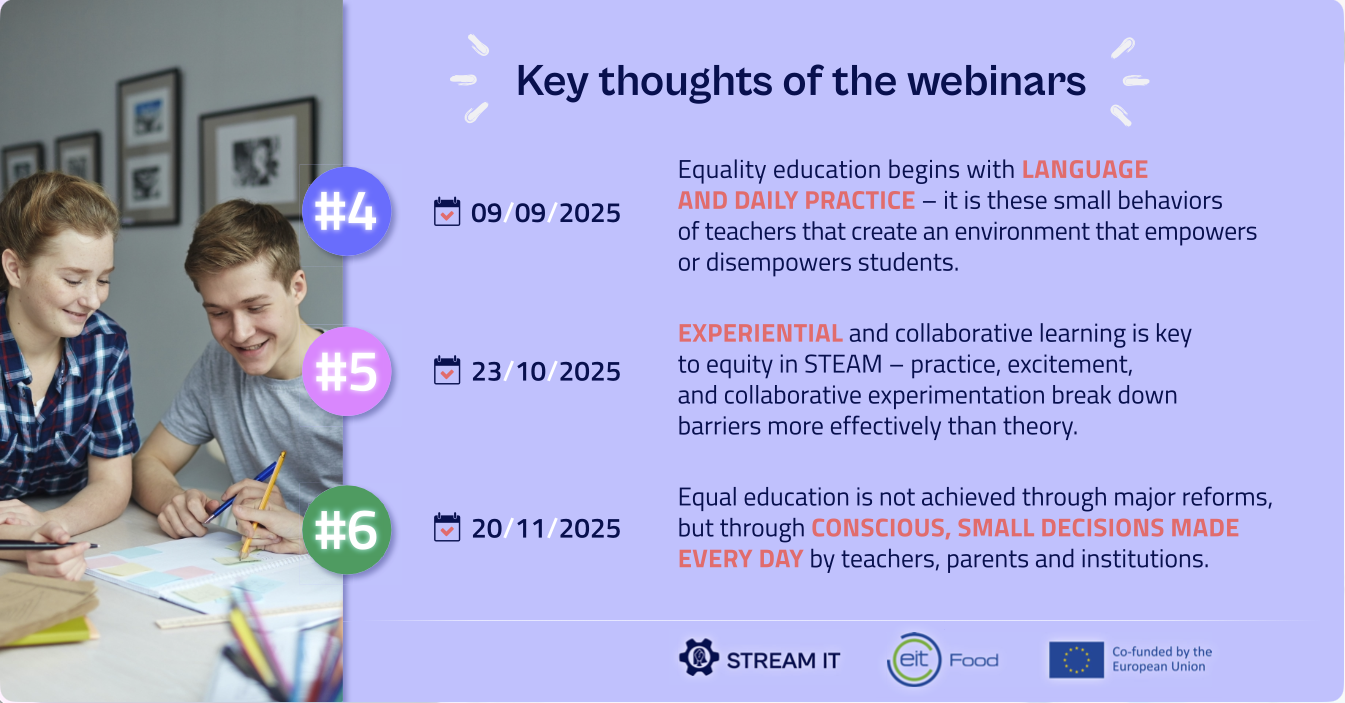
- Key Takeaway: Equality is a practice, not just a value. Schools must actively dismantle the “leadership for boys” vs. “support for girls” narrative by introducing gender-neutral health and science resources.
- Watch here: Youtube Link
- Additional recommendations:
- Start with supportive communication – Replace “typical for girls/boys” with “everyone can try” – and respond to stereotypes in class.
- Provide role models – Show women and men who succeed in “non-typical” fields; invite mentors, external experts to collaborate.
- Teach critical thinking about health – Debunk nutrition myths, analyse sources, discuss the impact of environment and lifestyle on health.
- Choose active methods – STEAM projects, culinary workshops, school gardens, shared breakfasts – quick ways to lasting habits.
- Use ready-made tools – Lesson plans and training offered by the FoodEducators program (including Kitchen Adventure) shorten the path from plan to action.
- Build a support network – Cooperate with local partners; share results with parents and the teaching staff.
5th Webinar: “Equality and Inspiration in STEAM Education: Supporting Young Explorers of Science”
Date: October 23rd, 2025
The Hook: How do we transform a standard classroom into a space where it’s safe to fail, experiment, and dream big? This session focused on “Learning by Doing,” showcasing how really small changes in leading lessons followed by cosmic-scale projects can inspire down-to-earth skills.
Dr. Waldemar Grabowski (Waldemar Grabowski Edukacja) and Marta Pietrow (ESERO Polska) took us on a journey through space education, highlighting the ESA CanSat competition and the Moon Camp Challenge. They argued that the teacher’s role is to be a “guiding light” for experimentation. By using mixed-gender teams and collaborative tools like Astro Pi, teachers can move students away from dry theory and toward a world where creative problem-solving is the core of scientific work.
- Key Takeaway: Mistakes are an essential part of the learning process. They provide a space for dialogue, empathy and collaboration. Passionate teachers who embrace failure as a step toward growth create students who aren’t afraid to tackle the complex challenges of the 21st century.
- Watch here: Youtube Link
- Additional recommendations:
- Encourage hands-on exploration – Simple materials can create powerful learning moments.
- Connect disciplines – Link science with art and humanities to boost creativity.
- Foster a culture of collaboration – Among students and teachers alike.
- Value diversity – Different perspectives enrich problem-solving.
- Use open resources – Initiatives offered for example by ESERO Polska and the Copernicus Science Centre from Poland offer free materials and workshops.
6th Webinar: “Supporting Educators, Shaping the Future”
Date: November 20th, 2025
The Hook: The final webinar wasn’t just a wrap-up; it was a “small revolution” in classroom practice. This closing session moved from institutional theory to the courageous daily actions teachers can take to build a more inclusive world.
An esteemed panel of experts debated the current landscape of Polish education and the critical path forward. Dr. Natalia Marciniak-Madejska (Social psychologist), Inga Stelmach (IT Girls Foundation), dr. Waldemar Grabowski (ESERO Poland), and dr. Jędrzej Witkowski (President of the Center for Citizenship Education) discussed the importance of systemic support for educators. They emphasised that change happens through “micro-actions” – from using gender-neutral language to ensuring girls have the psychological safety to fail and try again. By supporting the teacher’s awareness and pedagogical tools, we directly shape the future of every learner.
- Key Takeaway: The language we use shapes the world children imagine. Neutral, inclusive communication and “small revolutions” in daily teaching are the most powerful tools we have to build an equitable future.
- Watch here: Youtube Link
- Additional recommendations:
- Check the “order” before you leave the room – Are the materials you use equal, neutral, and inclusive?
- Normalise and encourage mistakes – intentionally – Build an atmosphere where mistakes are information, not punishment.
- Show real role models – Invite experts, mentors, and people from diverse backgrounds.
- Change one small thing each day – A new question, a new example, a new way of talking – small steps matter.
- Support student agency – Give choices. Let students decide. Encourage hands-on projects.
- Use open, inclusive language – Do not fear feminine forms. Use language that does not exclude.
- Build a culture of cooperation, not competition – Even small team projects create a sense of belonging.
Conclusion: A Community of Change
The Poland NIH webinar series has successfully demonstrated that when we support learners by dismantling barriers, we are effectively shaping the future of innovation. From foundational research to practical “space-age” classroom tools, we have built a roadmap for a more inclusive educational landscape in Poland.
The newly established National Inspiration Hub STEAM Poland is here to carry this mission forward. We invite all educators, researchers, and policymakers to join the movement – because when we remove the barriers, there is no limit to what our students can achieve.
Special thanks to Aleksandra Bara for her fantastic work in organising and bringing this series to life, and a huge thank you to all the speakers who joined us for this series! Your expertise and shared experiences are what made these sessions truly transformative for the next generation of STEM leaders.

F6S Innovation
Melissa Tang, Communication Manager at F6S Innovation, plays a pivotal role in various EU-funded initiative. Her expertise, built on a foundation of a BA in Design and Advertising and a Master’s in Communication and Media Studies, is further strengthened by hands-on experience leading communication, dissemination and exploitation efforts in over 15 research and business projects.